15 Security APIs for Asset Discovery, Fraud Detection and Threat Intelligence
A practical collection of security APIs for internet asset discovery, fraud and bot detection, reputation checks, credential monitoring, and application security.
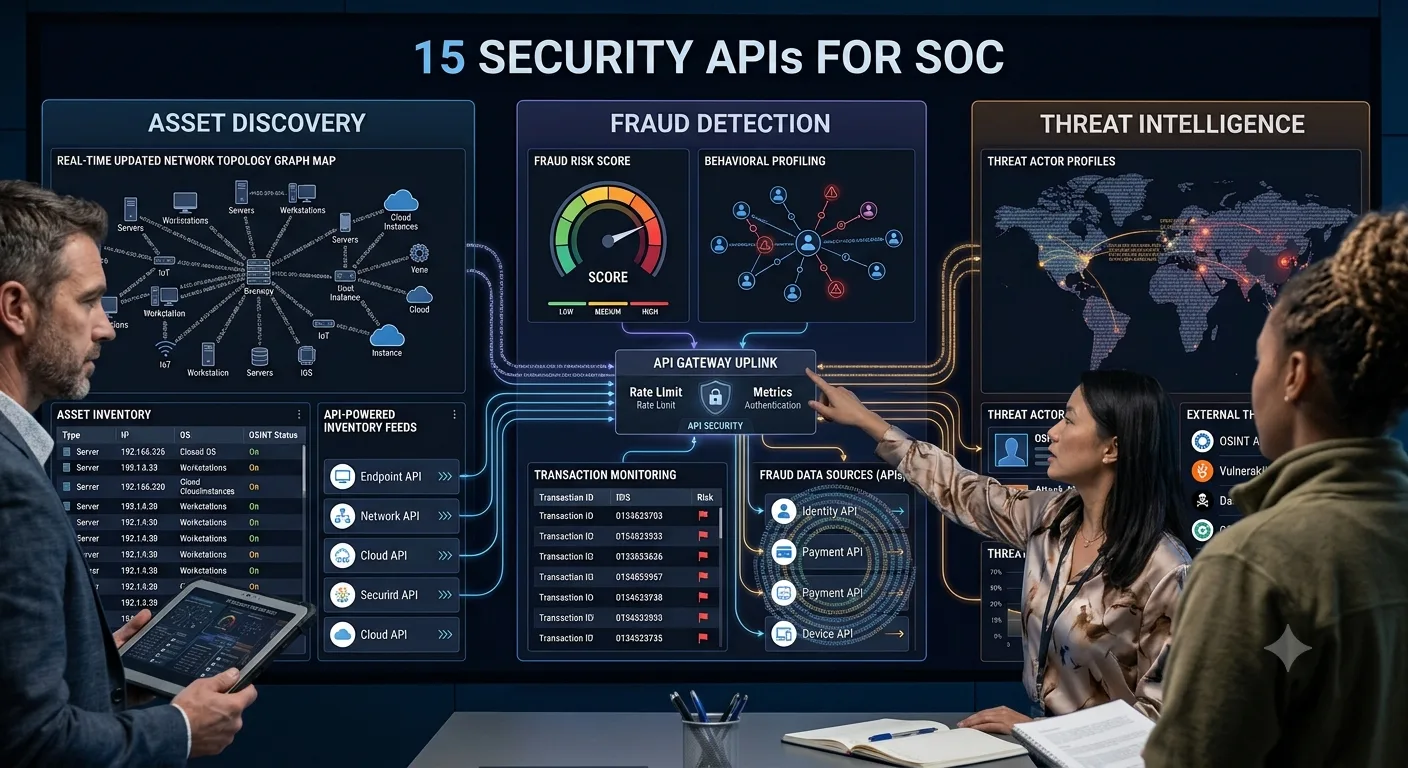
Security APIs let developers add specialized security data and checks to applications without building every detection system or intelligence dataset internally.
The APIs in this guide cover several distinct jobs: discovering internet-facing assets, identifying automated traffic, enriching risk decisions, checking reputation, monitoring exposed credentials, and strengthening software-development workflows. These services are not interchangeable, so the right choice starts with a clearly defined security objective.
Browse the full Security API category for more options.
Security API landscape
A useful way to evaluate security APIs is to group them by the decision they support:
- Asset discovery: What systems and services are exposed?
- Threat intelligence: What is known about an IP address, domain, email address, or other indicator?
- Fraud detection: Does a transaction or user session contain suspicious signals?
- Bot detection: Is the visitor likely to be automated?
- Credential monitoring: Have credentials or secrets been exposed?
- Application security: Does code, configuration, or the runtime environment introduce risk?
An API response should normally contribute to a broader decision. A single signal rarely proves that a user, device, address, or application is malicious.
Internet asset discovery APIs
Asset-discovery services help security teams understand systems visible from the public internet. Common uses include external attack-surface monitoring, inventory validation, exposure detection, and investigation.
1. BinaryEdge
BinaryEdge is a relevant APIsList entry for internet-facing asset and security-data workflows.
Potential applications include:
- Discovering exposed services
- Enriching IP-address investigations
- Monitoring infrastructure changes
- Supporting attack-surface inventories
Before integrating any internet-scanning dataset, verify its coverage, scan frequency, timestamps, and permitted uses.
2. FullHunt
FullHunt is another security listing relevant to external asset-discovery and attack-surface use cases.
Evaluate how the provider represents domains, subdomains, IP addresses, technologies, findings, and historical observations. Your internal asset identifiers should remain stable even when infrastructure changes.
3. Censys
Censys can be considered for applications that need searchable information about internet-visible hosts and services.
Useful evaluation questions include:
- Which protocols and services are represented?
- How quickly are observations refreshed?
- Can results be filtered by time and confidence?
- Is historical information available?
- How should duplicate or conflicting observations be handled?
4. Censys.io
Censys.io is also listed in the APIsList Security category. Because APIsList contains both Censys-related profiles, review both records and the provider’s current documentation before deciding which listing represents the integration you need.
Fraud and identity-risk APIs
Fraud APIs can provide useful signals about an account, transaction, device, email address, IP address, or behavioral pattern. They should support a risk model rather than silently replace one.
5. FraudLabs Pro
FraudLabs Pro is relevant to transaction and identity-risk workflows.
A production integration should distinguish among:
- Hard rejection rules
- Manual-review triggers
- Informational risk signals
- Provider errors or unavailable data
Record the reason for a decision and define what happens when the API cannot respond.
6. FingerprintJS Pro
FingerprintJS Pro is relevant to device and browser identification use cases.
Device identification may assist account-protection and abuse-prevention workflows, but it requires careful treatment of consent, privacy, retention, shared devices, and false matches. Do not use one identifier as the sole basis for an irreversible action.
7. EmailRep
EmailRep is an APIsList entry for email-reputation use cases.
Email reputation can support signup protection, account recovery, marketplace safety, and manual investigations. Check which fields are factual observations, inferred signals, or provider scores before mapping them into your own rules.
8. Complete Criminal Checks
Complete Criminal Checks is listed in the Security category for background-check-related use cases.
Background and identity information can be legally sensitive. Confirm the provider’s permitted uses, applicable jurisdiction, consent requirements, data-correction process, and restrictions before processing or acting on the data.
Bot and automated-traffic detection
Bot detection helps distinguish legitimate users, beneficial automation, search crawlers, abusive automation, and uncertain traffic. These are different groups and should not automatically receive the same treatment.
9. Botd
Botd is relevant to detecting automated browser activity.
A practical response strategy might:
- Allow clearly legitimate requests.
- Add friction to uncertain traffic.
- Rate-limit repetitive automation.
- Challenge high-risk requests.
- Block only when the evidence and business rules justify it.
10. Bingbot API
Bingbot API is relevant to crawler-verification workflows.
Crawler identity should be verified rather than trusted solely because a request claims a familiar user agent. Cache safe verification results where appropriate and design a fallback for DNS or provider outages.
11. FilterLists
FilterLists is relevant to applications that consume filtering and blocking lists.
When working with third-party lists, record their source, license, update time, intended purpose, and removal process. Lists can become stale or create false positives when used outside their original context.
Credential and exposure intelligence
Exposure intelligence can help security teams investigate leaked credentials, compromised accounts, and accidental publication of sensitive information.
12. Dehash.lt
Dehash.lt is listed for security-data and exposure-related workflows.
Handle breach or credential-related data as highly sensitive. Restrict access, minimize retention, log administrative use, and never expose raw sensitive results unnecessarily.
13. GitGuardian
GitGuardian is relevant to detecting exposed secrets in software-development workflows.
Secret scanning is most effective when integrated at several points:
- Developer workstation or pre-commit checks
- Pull-request and repository scanning
- Continuous integration
- Historical repository review
- Incident response and credential rotation
Detection alone is not remediation. Define who owns revocation, rotation, validation, and post-incident review.
Application and extension security
Some APIs focus on the application environment or software components rather than external threat indicators.
14. CRXcavator
CRXcavator is relevant to browser-extension security analysis.
Extension reviews should consider requested permissions, embedded dependencies, update behavior, publisher identity, data access, and changes between versions. Treat a score as a starting point for investigation, not a substitute for review.
15. Application Environment Verification
Application Environment Verification is an APIsList entry relevant to runtime or application-environment checks.
Before relying on environment-verification results, define the threat it is intended to detect and what action the application should take. A check that is useful for telemetry may not be reliable enough to block a legitimate user.
Comparison checklist
Use a structured evaluation instead of comparing providers only by the number of fields returned.
| Requirement | Questions to ask |
|---|---|
| Security objective | What precise attack, abuse pattern, or investigation does the API support? |
| Coverage | Which countries, networks, asset types, platforms, or data sources are included? |
| Freshness | When was each observation collected or updated? |
| Explainability | Can your team understand why a result or score was returned? |
| False positives | How can disputed or incorrect results be reviewed? |
| Availability | What happens to your product when the provider is unavailable? |
| Privacy | What user, device, transaction, or infrastructure data leaves your system? |
| Retention | How long may requests and responses be stored? |
| Licensing | Can results be cached, displayed, shared, or used commercially? |
| Support | Is there an escalation route for incorrect data and production incidents? |
Designing a production security integration
Normalize the response
Convert provider-specific fields into a stable internal model. Keep the original response for troubleshooting only where storage is permitted and necessary.
Separate signals from decisions
The API can return observations, classifications, or scores. Your application should apply documented business rules to decide whether to allow, challenge, review, or reject an action.
Design for uncertainty
Use an explicit state for unknown or unavailable results. Do not silently treat a timeout as either safe or malicious.
Protect sensitive requests and responses
Minimize submitted data, encrypt it in transit, restrict access, redact logs, and apply an appropriate retention period.
Measure production quality
Monitor:
- API availability and latency
- Unknown or incomplete responses
- Rules triggered by each signal
- Manual-review outcomes
- Confirmed false positives and false negatives
- Changes in provider coverage or response structure
Recommended APIs by use case
External attack-surface visibility
Start by reviewing BinaryEdge, FullHunt, and Censys.
Transaction and account-risk enrichment
Evaluate FraudLabs Pro, FingerprintJS Pro, and EmailRep against your actual risk rules and markets.
Bot and crawler controls
Review Botd, Bingbot API, and FilterLists.
Secret and exposure monitoring
Consider GitGuardian for secret-scanning workflows and Dehash.lt for relevant exposure investigations.
Software and browser-extension review
Review CRXcavator and Application Environment Verification.
Final guidance
The best security stack is rarely one API. Start with the security decision you need to improve, select the smallest relevant signal set, and test it against known legitimate and malicious cases.
Before deploying:
- Confirm current provider capabilities and documentation.
- Test coverage using representative production scenarios.
- Define how scores and observations affect decisions.
- Add a safe path for timeouts and unavailable data.
- Protect sensitive requests and responses.
- Review privacy, retention, and licensing requirements.
- Monitor false positives and operational failures.
- Reassess the integration as threats and provider datasets change.
Continue exploring the Security APIs available on APIsList.